

Missing teeth can significantly impact your oral health, confidence, and ability to eat comfortably. When facing tooth loss, dental professionals typically recommend two primary restoration options: dental crowns and dental bridges. According to the American Dental Association, nearly 120 million Americans are missing at least one tooth, highlighting the widespread need for effective restorative solutions. Understanding the structural differences, longevity, and maintenance requirements of each option is essential for making the best choice for your long-term oral health.
What Are Dental Crowns?
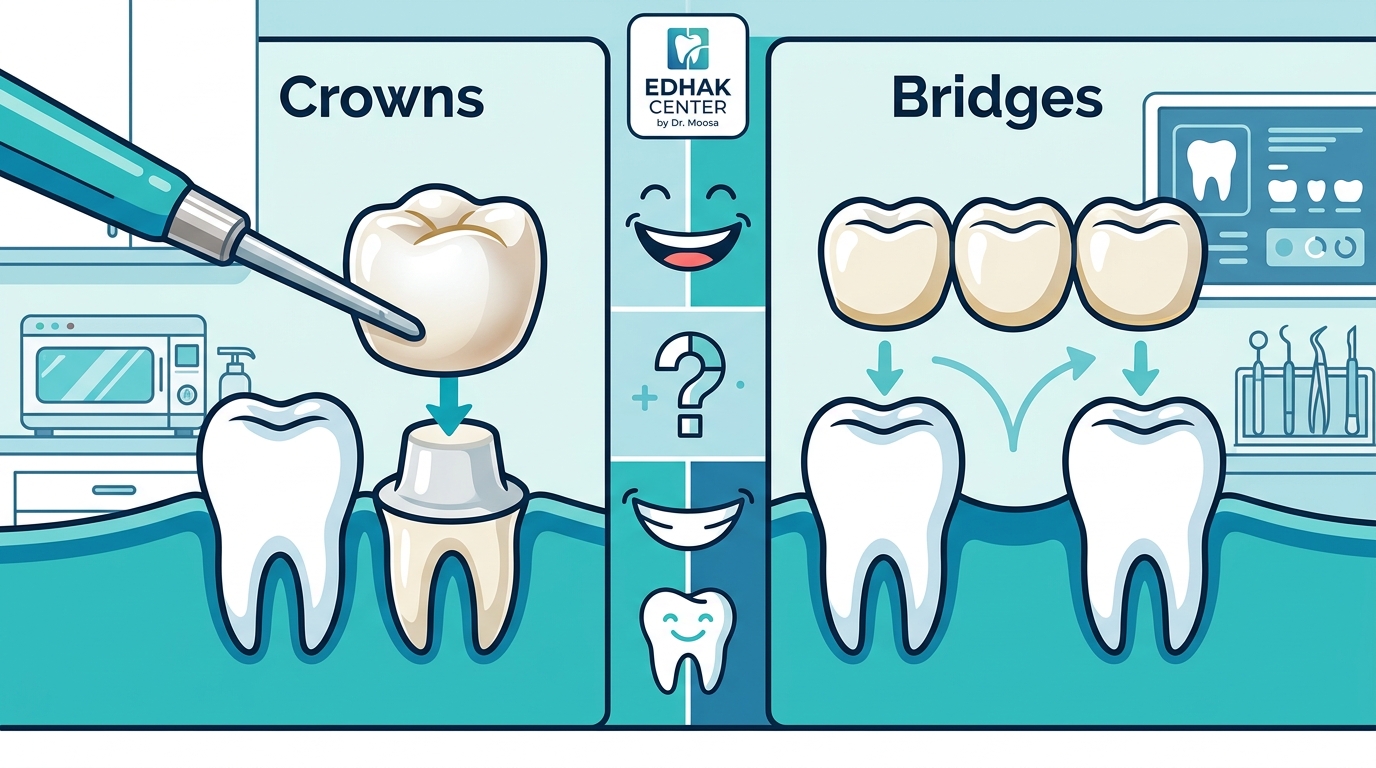
A dental crown is a custom-made, cap-like restoration that completely encases a damaged or weakened tooth. Dental crowns are designed to restore the shape, size, strength, and appearance of your teeth. They are typically used when a tooth has undergone significant decay, a large filling, or root canal treatment that compromises its structural integrity.
Crowns are fabricated from various materials, including porcelain-fused-to-metal, all-ceramic, zirconia, and gold alloys. At EDHAK Center, we utilize advanced digital impressions to ensure a precise fit that mimics the natural translucency and texture of your surrounding teeth. This precision is critical for both aesthetic harmony and functional durability.
The primary advantage of a crown is that it preserves your natural tooth root. By covering the remaining tooth structure, the crown protects it from further fracture while allowing you to maintain normal biting forces. This preservation helps prevent bone loss in the jaw, which often occurs when a tooth is extracted and left unreplaced.
Understanding Dental Bridges
A dental bridge is a fixed prosthetic device used to replace one or more missing teeth. Dental bridges are anchored to the adjacent natural teeth or dental implants. The bridge consists of a false tooth, known as a pontic, held in place by dental crowns cemented onto the abutment teeth on either side of the gap.
Bridges are an excellent solution for replacing missing teeth without the need for surgical implant placement. They restore your smile by closing the gap left by the missing tooth, which prevents neighboring teeth from shifting into the empty space. This shifting can lead to bite misalignment and increased risk of gum disease.
There are several types of bridges, including traditional bridges, cantilever bridges, and Maryland bridges. Traditional bridges are the most common, relying on crowns on both sides of the missing tooth. Maryland bridges use metal or porcelain wings bonded to the back of adjacent teeth, requiring less removal of natural tooth structure. Our specialists at EDHAK Center evaluate your specific dental anatomy to determine which bridge type offers the best stability and aesthetic outcome.
Key Differences: Crowns vs Bridges
Choosing between a crown and a bridge often depends on the extent of your tooth loss and the condition of your surrounding teeth. The following table summarizes the core distinctions between these two restorative options.
| Feature | Dental Crown | Dental Bridge |
|---|---|---|
| Primary Use | Restoring a single damaged tooth | Replacing one or more missing teeth |
| Impact on Adjacent Teeth | Minimal; only the damaged tooth is prepared | Significant; adjacent teeth must be filed down |
| Longevity | 10 to 15+ years with proper care | 5 to 15 years depending on hygiene |
| Cosmetic Result | Seamless integration with natural tooth | Highly aesthetic, but gum line may show |
| Procedure Complexity | Less invasive, single tooth focus | More complex, involves multiple teeth |
When you visit our dental services page, you will find detailed information on the materials we use for both crowns and bridges. We prioritize biocompatible materials that resist staining and wear, ensuring your restoration looks natural for years to come.
Cost and Insurance Considerations
Financial planning is a crucial part of the decision-making process. Generally, a single dental crown may cost less than a traditional bridge because it involves only one unit. However, if you are missing multiple teeth, a bridge might be more cost-effective than placing individual implants or multiple crowns.
Dental insurance often covers a portion of the cost for both crowns and bridges, typically classifying them as major restorative procedures. Coverage percentages vary by plan, but many policies cover 50% of the cost after the deductible is met. It is important to note that bridges require more extensive preparation of healthy teeth, which can sometimes lead to higher long-term maintenance costs if those abutment teeth require root canals or replacements in the future.
At EDHAK Center, we provide transparent pricing and work with patients to create manageable payment plans. You can review our dental FAQ for more details on insurance processing and financial options.
Maintenance and Long-Term Care
Both crowns and bridges require diligent oral hygiene to ensure their longevity. For crowns, you should brush and floss daily, paying special attention to the gum line where the crown meets the natural tooth. Flossing around a crown is similar to flossing around a natural tooth.
Maintaining a bridge requires slightly more effort. You must use special floss threaders or interdental brushes to clean underneath the pontic (the false tooth) and around the abutment crowns. Food particles can easily get trapped under the bridge, leading to decay in the supporting teeth if not removed regularly. Our team provides a comprehensive before and after gallery to show patients the aesthetic results of proper maintenance and professional care.
Regular dental check-ups are non-negotiable for both restorations. During your visits, our specialists will examine the integrity of the cement seal and the health of the underlying tooth structure. Early detection of any issues can prevent the need for more extensive treatment down the line. You can learn more about our dedicated team of specialists who are trained in advanced restorative techniques.
Key Takeaways
- Preservation vs Replacement: Crowns preserve your natural tooth root, while bridges replace the missing tooth entirely but require altering adjacent healthy teeth.
- Longevity: With excellent oral hygiene, both crowns and bridges can last 10 to 15 years or longer, though bridges may have a slightly shorter average lifespan due to the stress on abutment teeth.
- Aesthetic Integration: Modern ceramic and zirconia materials allow both restorations to blend seamlessly with natural teeth, providing a confident smile.
- Hygiene Requirements: Bridges require more complex cleaning routines, including floss threaders, to prevent decay under the pontic.
- Cost Efficiency: Crowns are generally less expensive for single-tooth issues, while bridges can be a cost-effective solution for multiple missing teeth compared to implants.
- Structural Integrity: Crowns protect weakened teeth from fracture, whereas bridges restore chewing function and prevent teeth from shifting.
- Professional Evaluation: The best choice depends on your specific dental anatomy, bone density, and overall oral health, necessitating a professional consultation.
Frequently Asked Questions
How long does a dental crown last?
With proper care and regular dental check-ups, a dental crown can last between 10 and 15 years, and often longer. Factors such as oral hygiene, diet, and grinding habits can influence its lifespan.
Are dental bridges painful?
The procedure itself is performed under local anesthesia, so you should not feel pain during the placement. After the anesthesia wears off, you may experience some sensitivity or mild discomfort for a few days, which can be managed with over-the-counter pain relievers.
Can I get a crown and a bridge at the same time?
Yes, it is common to receive both a crown and a bridge in the same treatment plan. Our specialists at EDHAK Center can coordinate the fabrication and placement of multiple restorations to ensure a cohesive and functional result.
Do bridges look natural?
Modern dental bridges are designed to look incredibly natural. We use high-quality porcelain or zirconia materials that match the color and translucency of your natural teeth, making the restoration virtually indistinguishable from your own smile.
What is the difference between a bridge and an implant?
A bridge relies on adjacent teeth for support, while a dental implant is a titanium post surgically placed into the jawbone. Implants do not require altering neighboring teeth and help preserve jawbone density, but they involve a longer treatment timeline and higher initial cost.
How do I clean under a dental bridge?
You should use a floss threader, superfloss, or an interdental brush to clean under the pontic and around the abutment teeth. Water flossers can also be effective for removing debris from beneath the bridge.
Is there a limit to how many teeth a bridge can replace?
Typically, a bridge can replace up to three consecutive missing teeth. Replacing more than three teeth may require additional support or alternative solutions like implants to ensure stability and prevent damage to the abutment teeth.
Schedule Your Consultation
Choosing between a crown and a bridge is a significant decision that affects your long-term oral health and quality of life. At EDHAK Center, we are committed to providing personalized care that addresses your unique dental needs. Our experienced team is ready to guide you through every step of the process, from initial assessment to final placement.
Do not let tooth loss compromise your confidence or health. Book an appointment with Dr. Moosa today to discuss your restoration options and take the first step toward a healthier, more beautiful smile. Visit our about page to learn more about our mission to deliver professional dental care in Egypt.